Saxophone Reed Care From Setup to Storage
Treat each reed as a working surface
Saxophone reed care begins with clean hands, careful mounting, approved moistening, gentle removal of surface moisture, and storage in a ventilated holder that supports the reed. Inspect the tip and rails before playing. Retire reeds with mold, contamination, sharp splits, or damage that makes response unpredictable or unsafe.
Handle by the thicker end
Remove a reed from its holder without touching or striking the thin tip. Hold the thicker stock and protect the rails. Follow the reed maker's instructions for moistening; do not assume soaking time, water temperature, or treatment applies across natural-cane and synthetic products.
Use clean personal equipment. Do not share reeds or communal soaking water, because mouth-contact equipment can transfer contamination between players.
Align without forcing
Place the reed on the mouthpiece according to the mouthpiece, ligature, and reed manufacturers’ instructions. Align the tip and rails as instructed, then secure the ligature without crushing or distorting the reed.
If the reed shifts repeatedly, inspect the ligature and setup. Do not overtighten hardware to compensate for incorrect fit.
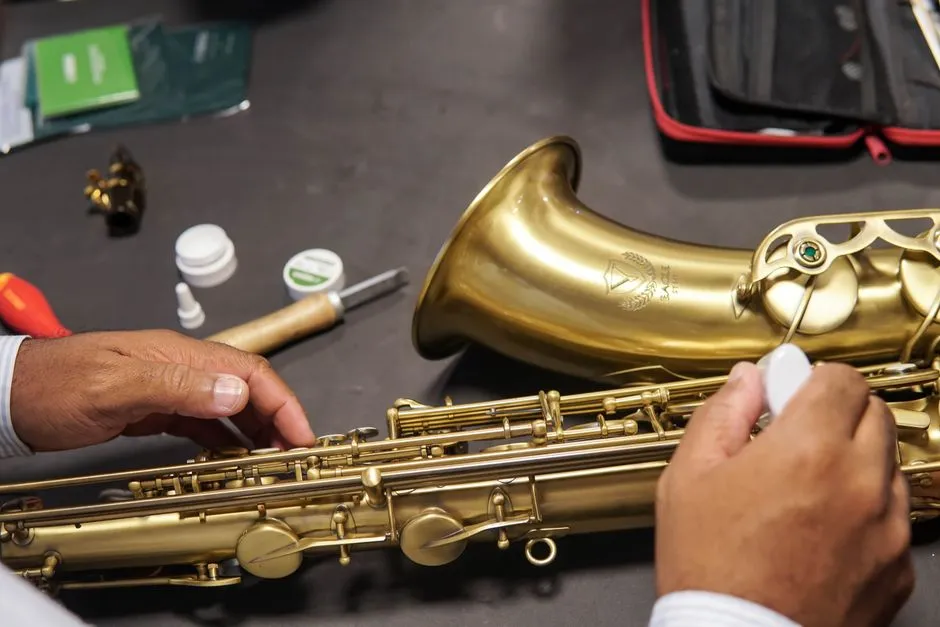
Safe saxophone assembly keeps this work supported away from key mechanisms.
Dry before storage
After playing, remove the reed carefully and follow approved cleaning or rinsing guidance for its material. Remove surface moisture without scraping the tip. Place it in a ventilated reed holder that keeps the facing supported appropriately.
Do not store a wet reed sealed against the mouthpiece. Let cases and holders dry as their makers direct.
Rotate and label reeds
Keep several playable reeds and rotate them across rehearsals and performances. Label holder positions and record response: easy attack, stable pitch, dynamic range, and any visible change.
Rotation does not make a damaged reed safe. Discard moldy, contaminated, split, or sharp-edged reeds.
Compare response, not printed prestige
Reed numbers and cuts are product-specific. A larger number does not automatically mean advanced, darker, better, or more correct. Match response to the mouthpiece, instrument, player, and musical task.
Our reed-strength guide uses controlled comparisons rather than status.
Keep mouthpiece care separate
A clean mouthpiece supports reed hygiene, but mouthpiece materials require specific methods. See how to clean a saxophone mouthpiece and follow the maker. Do not apply unapproved disinfectants, bleach, alcohol, solvents, or heat. Chemical products can irritate the lungs, skin, or eyes. If unexpected inhalation, skin, or eye exposure occurs, contact a local poison center for case-specific guidance; in the United States, Poison Control provides online help and 1-800-222-1222. Call local emergency services for severe breathing difficulty, collapse, or other life-threatening symptoms.
Know when the problem is elsewhere
Several poor reeds may actually point to mouthpiece damage, ligature fit, instrument leaks, embouchure pressure, or storage conditions. Compare a known responsive reed and ask a qualified teacher or technician to assess recurring problems.
Good reed care cannot make every piece of material identical. It supports clean handling, reliable records, safe storage, and enough comparable reeds to replace one that becomes unreliable.
Keep the holder clean
Keep the reed holder itself clean according to its manufacturer. A reed placed into a contaminated or persistently wet holder does not remain clean merely because its own surface was handled correctly.